Many women aren’t “insensitive,” but rather, no one has truly told them where the clitoris is, what it looks like, and how to find it. This article will explain these basics clearly, so you don’t have to feel embarrassed, guess, or rely on others’ “experience.” You’ll learn how to accurately locate the clitoris, how to determine the structure of the foreskin, how to clean it safely, and what changes occur when the clitoris becomes aroused. By following the steps, you’ll become more familiar with your body, laying a solid foundation for the next article, “How to Stimulate the Clitoris.”

How to locate the clitoris (from visual to tactile steps)
Finding the clitoris isn’t about “finding treasure,” but rather about gaining a better understanding of your body’s structure. If you’ve never really seen it before, that’s perfectly normal. The steps below will allow even beginners to locate it safely and easily.
Find a comfortable position first.
You can lie down or half-lie down, allowing your pelvis to relax naturally. Placing a soft light on one side will make it easier to see clearly.
Prepare a small mirror.
Place a mirror between your legs so the area is well lit. You will see the mons pubis, labia, urethral opening, and vaginal opening—the clitoris is located “above” these structures, but its appearance varies from person to person.
Key points of visual positioning:
- The clitoris is usually located directly above the vaginal opening and is covered by a small fold of skin (clitoral hood).
- Some people have a more prominent clitoral glans, while others have a more concealed one; both are perfectly normal.
- You may see only a “small dot,” or you may notice a slightly larger piece of tissue, depending on your anatomy.
Next, let’s focus on touch.
Gently separate the labia with clean fingers, moving slowly upward from the vaginal opening. You will feel a more sensitive spot with a slightly different texture—the clitoral glans or the area beneath the hood.
Common misconceptions: Be sure to avoid the following incorrect judgments:
- Mistaking the urethral opening for the clitoris. The urethral opening is located below the clitoris, closer to the vaginal opening. It does not produce a “shock” or sensitive reaction when touched like the clitoris.
- Feeling like you “can’t find it.” Some people have a smaller or more internal clitoris, but that doesn’t mean it’s not there; it’s usually easier to find when you touch it from a different angle or by slowing down.
- Treating “different shapes” as abnormal. The diversity of clitoral appearance is perfectly normal, much like noses or lips—everyone’s looks different.
Through visual and tactile confirmation, you will become more and more familiar with your own anatomy and gradually find the most comfortable way to explore.
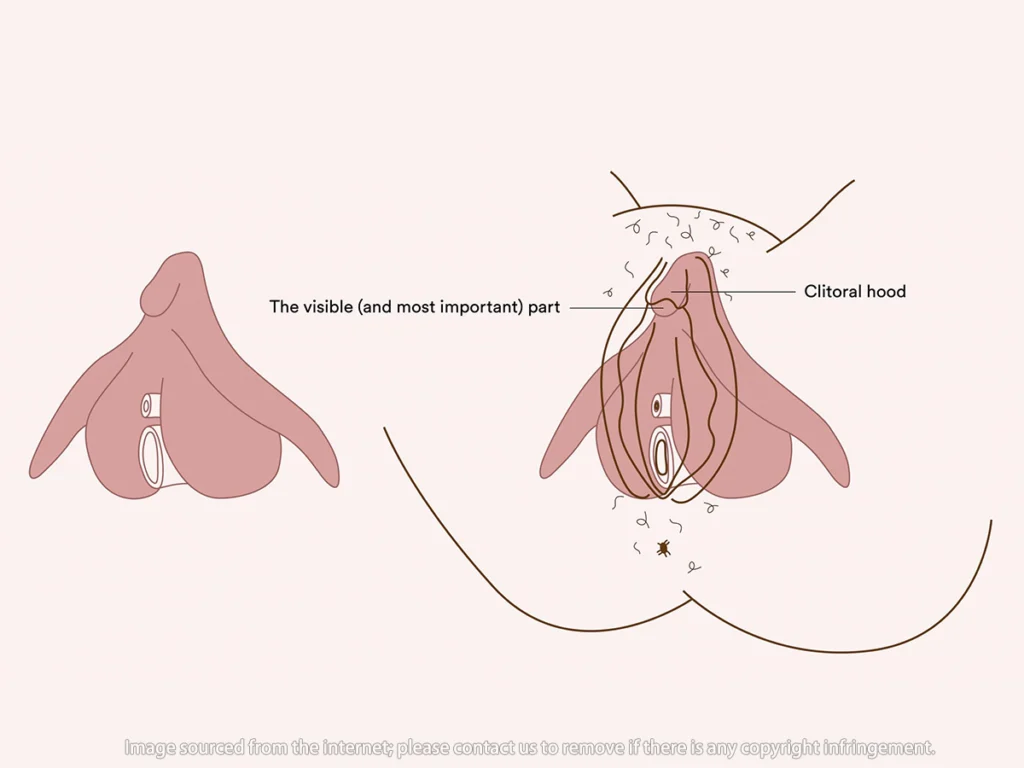
What is the function of the clitoral hood? Does it need to be retracted?
The clitoral hood is a small fold of skin covering the glans clitoris. Its presence is not “unnecessary design,” but rather a natural mechanism the body uses to protect this hypersensitive area. Understanding its function will help you feel more comfortable and safer when exploring your body.
What is its main function?
- Physical protection. The clitoral glans has an extremely high nerve density, and even ordinary friction in daily life can cause discomfort. The hood reduces friction from clothing, bacterial contact, and external irritants.
- Maintains moisture. The foreskin helps retain natural secretions, preventing the tissue from becoming dry or sensitive and painful.
- Regulates sensitivity. During sexual arousal, the foreskin retracts slightly due to engorgement, making the clitoral glans more exposed and providing more direct stimulation; in a non-excited state, it can reduce sensitivity to an acceptable range.
Do I need to retract the hood?
Normally, it’s not necessary. The clitoral hood is there to protect the clitoris, not to make you work hard to push it back.
- For highly sensitive individuals, forcefully lifting it will cause a stinging sensation—this is the body telling you “you’ve gone too far.”
- When excited, it will naturally retract, and there’s no need to intervene manually.
- If your foreskin is naturally tighter, longer, or easier to cover, that’s perfectly normal; it’s just a structural difference.
How can I operate based on my own sensitivity?
- If you are naturally sensitive: simply leave your fingers on the surface of the foreskin when touching it; the foreskin itself can also transmit stimulation.
- If you are less sensitive: you can gently slide the foreskin back a little, but the movement should be slow and you should feel completely comfortable.
- If it hurts when touched: it means that direct exposure is too strong for you. You can touch only the outer layer of the foreskin and not force the clitoral glans to be exposed.
The presence of the clitoral hood is not an obstacle to pleasure, but rather part of a protective mechanism. Learning to cooperate with your own sensitivity, rather than fighting against it, will make subsequent practice of stimulation techniques more natural and enjoyable.

How to clean the clitoris?
Cleaning the clitoris is not complicated; the key is to be gentle, keep it simple, and respect the body’s natural balance. Over-cleaning may irritate sensitive areas or even disrupt the natural flora around the clitoris.
Basic cleaning steps:
1. Simply rinse with warm water.
Gently wash your vulva with warm water daily, including the clitoris and clitoral hood area. If you wish, you can also gently separate the hood to allow the water to wash away surface secretions, but there is no need to use force.
2. Avoid using harsh cleaning agents.
Soaps, shower gels, and fragranced washes can disrupt the natural balance, increasing the risk of irritation or infection. Sex educators generally recommend that water alone is sufficient for vulvar cleaning—it’s simple, effective, and safe.
3. Correct wiping sequence
Wipe gently from front to back to avoid bringing bacteria from the anal area to the urethra or vaginal opening.
4. Keep underwear clean and breathable.
Choosing soft, breathable cotton underwear and changing it frequently can reduce moisture buildup and the possibility of bacterial growth.
Common mistakes to avoid:
- Do not douche (the vagina has a self-cleaning function).
- Do not use fragrance sprays, disinfectants, or any harsh cleaning agents.
- Avoid excessive friction or vigorous scrubbing of the area under the foreskin to prevent pain or hypersensitivity.
When should you consider consulting a doctor?
- Even after cleaning, there is still a noticeable buildup of secretions or an odor.
- Pain, burning sensation, or redness and swelling may occur.
- There is an abnormal color or discomfort that persists.
Warm water, gentle techniques, and clean, breathable underwear are the simplest and most effective ways to maintain clitoral health—no excessive washing or force is needed.

Can the clitoris become erect? How can it be identified?
The clitoris can indeed become erect, and this is a completely normal physiological response. It is composed of corpora cavernosa, similar to the principle of penile erection in men: when blood flows into the corpora cavernosa and they become engorged, the clitoris swells slightly, hardens, and its sensitivity increases.
How to identify clitoral erection:
- Location: At the top of the vulva, where the labia minora meet, under the foreskin.
- Visual changes: During sexual arousal, the clitoral glans may be slightly larger or more prominent than usual, and its color may also be slightly darker.
- Changes in texture: When touched lightly, it feels firmer or more elastic than usual.
Individual differences
Erection levels and response speed vary from person to person, influenced by hormone levels, psychological state, and even the menstrual cycle. Some people experience noticeable changes, while others see them more subtly, but all are within the normal range.
Brief overview of the physiological mechanism
Sexual stimulation transmits nerve signals to the spinal cord and brain, causing local blood vessels to dilate and the corpora cavernosa to fill with blood. This engorgement makes the clitoral glans easier to stimulate, while also increasing sensitivity and pleasure.
Understanding this can help you better recognize your body’s signals and lay the foundation for learning stimulation techniques later.
How to stimulate the clitoris (hands, mouth, and during sex)
Now you have learned how to locate the clitoris, understand the function of the clitoral hood, master cleaning methods, and know the natural changes that occur in the clitoris when it is aroused.
If you want to transform your understanding of your body into a pleasurable experience, you need to not only find the clitoris, but also know how to gently and effectively stimulate it. Next, I will guide you through a systematic understanding of various ways to stimulate the clitoris, ensuring that every step from understanding your body to mastering pleasure is safe and scientific.